Wednesday, November 10, 2010

Happy 235th Birthday to the Marine Corps

Here is my third annual traditional Marine Corps Birthday joke. Hadn’t heard it in a while, and I like this version from the Its Humor blog the best.
The Best "Dear John" Letter ever...

A Marine stationed in Iraq recently received a "Dear John" letter from his girlfriend back home. It read as follows:
Dear Ricky,
I can no longer continue our relationship. The distance between us is just too great. I must admit that I have cheated on you twice, since you've been gone, and it's not fair to either of us. I'm sorry.

Please return the picture of me that I sent to you.

Love,
Becky
The Marine, with hurt feelings, asked his fellow Marines for any snapshots they could spare of their girlfriends, sisters, ex-girlfriends, aunts, cousins etc. In addition to the picture of Becky, Ricky included all the other pictures of the pretty gals he had collected from his buddies. There were 57 photos in that envelope....along with this note:
Dear Becky,
I'm so sorry, but I can't quite remember who you are. Please take your picture from the pile, and send the rest back to me.

Take Care,
Ricky
Semper Fi!


Full blog post...

Sunday, November 7, 2010

The Bluebook and Daylight Savings Time

Turning our clocks back last night reminded me of this minor, minor citation issue. Wow - its so minor, I can’t believe I’m taking time to write about it. But I haven’t been writing so much in here lately, and since one of the things I used to do regularly is complain about other people’s sloppy citation errors, I thought I would sling some more mud around. Remember, this is a minor, minor issue.

I had to cite some e-mails in an article I wrote a couple of years ago, and did some searches to confirm that a lot of people really don’t pay any attention to this. Bluebook Rule 17.2.4, E-Mail Correspondence and Listserv Postings, says “[w]hen citing personal e-mail messages...[t]he date of the message and the time stamp may be needed for specific identification of the message”.

Yes, the date would be useful, but why the time? I guess if the author were citing a near-real time e-mail exchange, putting the time-stamps in the citation would help clarify the order the e-mails were sent. And though its not a strict requirements, most folks seem to do it. And many people botch the time stamp of e-mails.

Consider the Eastern time zone. Searching Westlaw’s JLR database for the abbreviation of “Eastern Daylight Time”, I found mostly correct usages, but the seventh document I came across had it wrong:

Leslie Gielow Jacobs, Bush, Obama and Beyond: Observations on the Prospect of Fact Checking Executive Department Threat Claims Before the Use of Force, 26 Const. Comment. 433 (2010):
Persuasive communications by executive branch officials have included formal speeches,123 Sunday talk show appearances,124 congressional testimony,125 direct media postings,126 and documents delivered to Congress and released publicly.127

126E.g., Posting of Jesse Lee to the White House Blog, The New Way Forward--The President's Address, http:// www.whitehouse.gov/blog/2009/12/01/new-way-forward-presidents-address (Dec. 1, 2009 21:35 EDT).
(Emphasis added.) December would actually be Easter Standard Time, i.e., “EST”.

Maybe people just don’t realize that the abbreviations for the time zones change according to whether we’re on Standard time - in the winter - or on Daylight time - in the summer. If they realize that, its easy to mix them up because its counter-intuitive: summer is “daylight” time and the winter is “standard” time. It seems that it would be the other way around. After all, we move our clocks back and forward twice a year so farmers have more daylight, right? And isn’t the winter the darker time of the year, when we need to save the daylight? But, no, it’s the other way - winter is standard time and summer is daylight savings time. As the National Institute of Science and Technology’s Physical Measurement Laboratory puts it:
At present, Daylight Saving Time in the United States ... begins at 2:00 a.m. on the second Sunday of March and ... ends at 2:00 a.m. on the first Sunday of November.
So only one of the first ten articles I found with a time stamp that included “EDT” got it wrong. I thought I would also try “EST”. That turns up a lot of French phrases or titles. But the second time zone abbreviation I found is incorrect:
Cynthia Baker, Robert Lancaster, Under Pressure: Rethinking Externships in a Bleak Economy, Clinical Law Review 17 Clinical L. Rev. 71 (2010):
Additionally, default rates for student loans of recent law school graduates have increased sharply.FN24

24Access Group, Inc., a primary originator and servicer of private education loans for law students, reports that the default rate for law student loans jumped between the law school classes of 2007 and 2008. E-mail from Jeffrey E. Hanson, Dir., Borrower Educ. Servs., Access Group to Cynthia Baker, Dir., Program on Law and State Gov't, Ind. Univ. Sch. of Law-Indianapolis (Aug. 11, 2010, 3:42 p.m. EST) (on file with authors).
(Emphasis added.) August is actually part of Daylight time, i.e., EDT. Funny thing is, another six of the first ten time stamps that include EST were also incorrectly used for e-mails or postings sent on dates during Daylight times, for a rate of only a thirty percent correct usage. Don’t know why many more people use “EST” wrong than “EDT”.

But no one can be blamed for getting this wrong in a law review article since the example in the Bluebook for this rule muffs it at well:
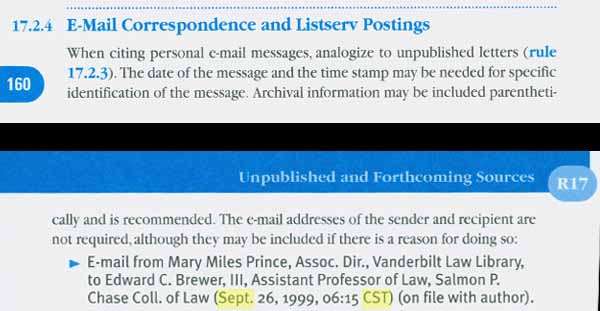
Bluebook Rule 17.2.4


September, yes, is, and always has been, part of Daylight time.

Full blog post...

Monday, October 4, 2010

Justice Elena Kagan and Empathy versus Compassion

Completely separate from any jurisprudential significance of one third of the Supreme Court now consisting of women and all the news today that mentioned that fact now that Justice Kagan took her place on the high bench, we now have two justices that President Obama has appointed to the Supreme Court and who both, presumedly, meet the President’s criteria of possessing “‘empathy’ for "people's hopes and struggles’”, that he said was important when he faced his first Supreme Court vacancy last summer.

I tracked down a lot of resources and articles about empathy and jurisprudence for a professor this summer, and with Kagan’s “First Monday” today I was reminded of a blazingly obvious problem with the use of the word. Obvious, at least, to anyone who consults a dictionary.

President Obama, in “The Audacity of Hope”, characterizes empathy as “a call to stand in someone else's shoes and see through their eyes.” (No direct cite available on-line, but the quote is referenced both here and here.)

That’s pretty on point with the OED definition of empathy (gotta have your own local subscription/access to follow that and the next link):
The power of projecting one's personality into (and so fully comprehending) the object of contemplation (specifically the second definition, which is the one most relevant to the present discussion of judicial philosophies).
Contrast that with the OED definition of compassion:
The feeling or emotion, when a person is moved by the suffering or distress of another, and by the desire to relieve it; pity that inclines one to spare or to succour.
Explicit in the definition of compassion is that the subject of our compassion is suffering or in distress and if we’re compassionate we will be moved to work to spare or succour the party that is suffering or in distress. In contrast, the strict dictionary definition of empathy says nothing about what, if anything, is happening with the subject of our empathy, and also says nothing about whether by being empathetic we will be motivated to do anything about the subject of our empathy.

My ultimate point is that, very strictly speaking, empathy is value-neutral, but the empathy that most commentators have written about, and that President Obama wrote about in his book and spoke about when nominating Justice Sotomayor, is definitely not the strict, value-free dictionary-definition variety of “empathy”; the better word to have used in all these instances would have been “compassion”.

But with politics being what it was, and with President Obama lacking, as I said in another context, the courage of his convictions, he would have faced even more scorn for using “compassion” to describe his ideal judicial candidate than “empathy”. And I think that’s probably why “empathy” has been used in all the legal scholarship I found this summer: it’s a more academic term, a slightly less “touchy-feely”, greeting-card term, but strictly speaking, I think Obama and his fellow travelers want judges and jurisprudence that are compassionate, not empathetic.

One could, strictly speaking, say you feel empathetic for the homeowner who blew away a burglar with his shotgun and was acquitted because of justifiable homicide (to use a random, bizarre example that came to me when thinking about all this). That would be an awkward use of the word, but not incorrect given the OED definition (the more commonly used term would be sympathetic, of course).

Again, since empathy is defined as “the power of projecting one's personality into (and so fully comprehending) the object of contemplation” it says nothing about what that object of contemplation is or what the object it. I think we could legitimately argue that the majority opinion in Bowers v. Hardwick that was truly empathetic: empathetic with the the legislators, citizens, and lawmen of Georgia who passed, supported, and enforced the anti-sodomy law that the Supreme Court upheld in that case (to take another random example that comes to mind). But that’s not the empathy that the legal literature contemplates because the “wrong” party prevailed in that case: the party that was suffering, distressed, and which were deserving of pity and to which most commentators were inclined to spare or succour, to use the terms from the OED definition of “compassion”, but not the definition of empathy.

To use a related, but more current, example: Obama surely hopes that now with Justices Sotomayor and Kagan on the bench, when California's Proposition 8 reaches the high court, a majority of the justices will be compassionate to the "suffering or distress" of the same-sex couples denied the benefit of marriage by Prop. 8 and not empathetic to the majority of citizens represented in that case, those who passed Prop. 8 in the first place. The value-neutral OED definition of empathy would seem to require a cold, value-neutral weighing of the “full comprehen[sion]” of the various “object[s] of contemplation” and rule on the side that had the most numbers, regardless of which side warranted "the desire to relieve" any afore-mentioned suffering and distress, as a compassionate approach would require.


Full blog post...

Tuesday, September 28, 2010

Blogging Drought?

Almost two months with only two blog posts to show for these hot summer months? And with two years now and 150 or so posts this far!!!???!!! (What the hell did I write about in all those posts?)

Guess when I’m working on something substantive I have less time and energy to bullshit blog. I must be such a disappointment to my one “follower” and all the Taiwanese porn spammers who make it past the CAPTCHA screening.

Full blog post...

Thursday, September 9, 2010

2010 New Orleans Saints Who Dat Nation Membership Quiz

On the occasion of the start of the regular season today, all Saints fans should take the following quiz to determine their true level of committed Who Dat-ness!

1) The 2010 Super Bowl Champion New Orleans Saints were:

A) The greatest team fielded by the Saints in franchise history.

B) The greatest team fielded by any NFL franchise in league history.

C) The greatest team ever fielded in any sport in all of history from the dawn of time to the end of the universe.

2) The Saints' successful on-side kick at the start of the second half of Super Bowl 44 was:

A) The gutsiest play ever called in a Super Bowl game.

B) The gutsiest play ever in any football game.

C) The single most significant strategic decision ever made by a human being.

3) Tracy Porter’s fourth-quarter Super Bowl interception that took the Saints to their decisive 31 to 17 winning lead was:

A) The best turnover play in the history of the Super Bowl.

B) The best and most decisive victory-sealing play in the history of sports.

C) The single greatest accomplishment in human history, surpassing agriculture, writing, and the discovery of fire.

4) New Orleans Head Coach Sean Peyton is:

A) The best coach the New Orleans Saints have ever had.

B) The greatest coach ever to walk the face of the Earth.

C) The most supreme strategist ever to command men, usurping all other piker wannabes like Napoleon, Rommel, and Sun Tzu.

5) New Orleans Saints Quarterback and Superbowl 44 MVP Drew Brees is:

A) The greatest quarterback in Saints history.

B) The greatest athlete ever in human history.

C) So amazing and all-encompassing in his athletic skills and leadership abilities that he transcends human experience and cannot be fully appreciated by such mortals as we who are merely fit to touch the hem of his jersey as we grovel before him and avert our gaze from his face.

Answer Key: If you answered anything but “C” to any of these questions, burn all your Saints memorabilia and gauge your eyes out before game time because you do not deserve to call yourself a true member of the Who Dat Nation.


Full blog post...