Showing posts with label New York Times. Show all posts

Tuesday, September 23, 2014

New York Times: One Letter, One Hell of Typo

Reading yesterday’s New York Times - in print - this sentence caught my eye:


Wait, why was someone protesting “the Church of Scientology for the Killing of Michael Brown in Fergeson, Mo.” ?

Of course, it’s a typo, but a hell of a typo: that same article on-line now reads:


"For" vs "or" - a single letter makes a big difference. The online version also has a correction statement apologizing for the error; the print version, as of this morning, did not.

Full blog post...

Monday, August 12, 2013

New York Times’ On-Line Revisions: No Notice? No Comment? No Correction?

I thought the New York Times had a policy that, if the on-line version of a story was changed to reflect some error, a note would indicate that at the bottom of the story. And if the error was also in the original print story, the paper would soon publish a correction.  

In Friday’s print edition, David Brooks’ column, The Nudge Debate, focused on possible applications of techniques discussed in Nudge, by Cass Sunstein’s, and which Prof. Sunstein has recently expanded upon in a lecture at Yale (and which will be the subject of his next book, Nanny Statecraft). “Nudge” is all about small measures governments can take to influence public behavior: making organ donation on drivers’ license application forms opt-out, instead of opt-in, that sort of thing. 

In Brooks’ print column, he says the Obama administration has created a “Behavioral Insights Team” to apply such techniques to their policy goals. But the on-line version only says that the administration has “announced that it is creating” such a team. Big, big difference, and no indication in the on-line article, or on the corrections page, about this change:

  
Did Brooks rush his original column and confused the Behavioral Insights Team established in the UK with possible similar efforts here? Does he do his research at InfoWars.Com? The Obama administration is really just at the applicant solicitation stage. So, New York Times? What’s up with the on-line change and no correction (as of today)?
Full blog post...

Monday, May 16, 2011

Italian Combat Readiness in WWI

In yesterday's New York Times Book Review, the title review, by Christopher Hitchens, is Adam Hochschild, To End All Wars: A Story of Loyalty and Rebellion, 1914-1918, a new book on WWI.

What caught my eye is this accompanying photograph:


The caption in the review reads “Italian soldiers killed during an Austrian attack in the mountains near Cividale, circa 1917.” Well, no freaking kidding they were killed - they brought a damn guitar into combat - that shows where their priorities were!

Full blog post...

Tuesday, May 3, 2011

Is the New York Times and/or Stephen L. Carter Wrong?

Ok, so this isn’t the most timely comment. I’m catching up on stuff and cleaning off my desk after meeting two big deadlines in the past month, which is why this may have been, I think, the biggest gap in posts since I started this blog way back in aught-eight.

I had flagged James Traub’s review of Yale Law Professor Stephen L. Carter’s book, The Violence of Peace: America’s Wars in the Age of Obama, in the New York Times Book Review from back in - jeez! - January. Carter apparently takes Obama to task for continuing the Bush wars without any improved adherence to the “just war” theory that is the focus of Carter’s book.

The quote in the review that caught my eye was this:
Carter observes that the Bush administration coined the term “unlawful combatant” to place America’s new adversaries beyond the reach of the Geneva Conventions.
I read that and though, uhh, doubtful. Five minutes with Westlaw found several cases from WWII and the 1950s about “unlawful combatants”.

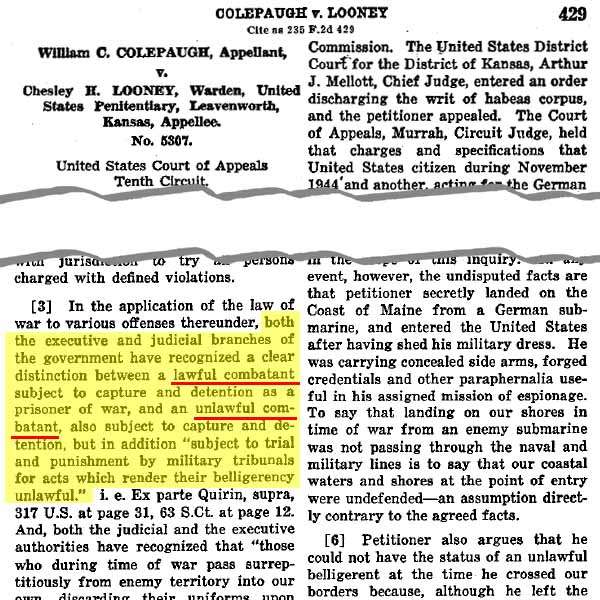
Here’s the relevant part of one such case, Colepaugh v. Looney, 235 F.2d 429 (10th Cir. 1956):

Colepaugh v. Looney

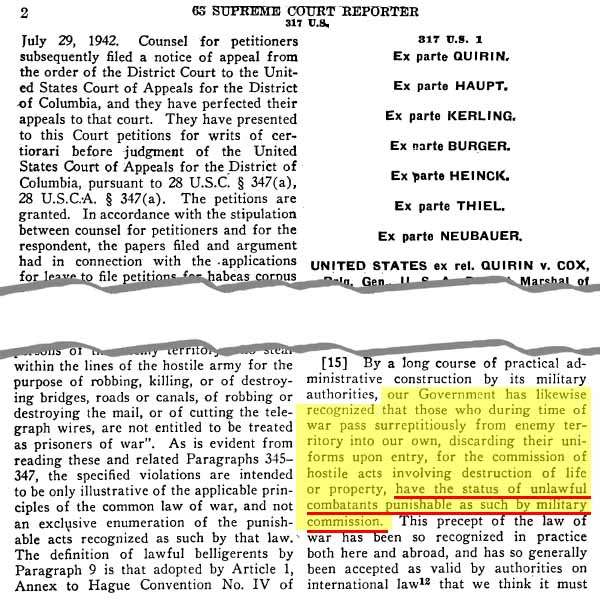
The case it cites is a Supreme Court case from WWII, Ex parte Quirin 317 U.S. 1 (1942), which says:

Ex parte Quirin

I’m no expert in this subject, but either 1) Stephen Carter is wrong - doubtful - 2) the NYT reviewer is wrong - possible - or, most likely, 3) the NYT reviewer was lazy in summarizing Carter’s statements about unlawful combatants and the Bush administration. Like all law professors, Carter is very likely a genius at grafting multiple layers of conditions and clarifications on anything he says. We have the book, and I really don’t want to read it just to find out about this, but I might have to because, based on the Traub review, Carter is absolute wrong and has completely mis-represented the Bush administration’s use of the unlawful combatant status in military law during its eight years, seven and a half of which were engaged in the war on terror, which Obama’s recent good luck in continuing Bush’s policies will probably do little to help resolve.

Full blog post...

Thursday, December 16, 2010

Duelling Henry James Quotes in the New York Time

It was deja vu, all over again. I read last Sunday's New York Times article about Bernardo Bertolucci the other day, and it starts out his quoting a passage from a Henry James story, "The Middle Years":
“We work in the dark — we do what we can — we give what we have. Our doubt is our passion, and our passion is our task. The rest is the madness of art.”
A great line about artistic endeavor. So great, another writer used it in another article. I only just finished the book review section, and in the concluding essay, "Working on the Ending", by Gail Godwin, she uses the same quote, albeit without the great last line about madness:
“We work in the dark — we do what we can — we give what we have. Our doubt is our passion, and our passion is our task.”
Was this a recent quote of the day on some desk calendar? It was also used in the Times a few weeks ago, in an article about a museum opening, at which the quote was recited by a speaker. But besides this recent cluster, this quote has only appeared four times since 1981 in the NYT, and only once prior to that, according to their archives search.

Explanation? I'll have to defer to someone I'm much more likely to quote myself instead of Henry James:
A star fall, a phone call
It joins all
Synchronicity

It's so deep, it's so wide
You're inside
Synchronicity

Effect without cause
Sub-atomic laws, scientific pause
Synchronicity

Full blog post...

Monday, September 7, 2009

3 Weeks Out: Finally a NYT Book Review Katrina Correction

I guess other folks more concerned and more motivated about this than myself took a bit more effort to point out the problems with Timothy Egan's book review of Dave Eggers' Zeitoun: the Sunday NYT Book Review yesterday had a correction and there is now one appended to the on-line version of the review.

Here in New Orleans, the Times-Picayune did a bit of a better job by quickly publishing a letter to the editor from the founder of Levees.Org about President Obama's characterization of Katrina as a "natural disaster". That statement was made in an interview with the President by local reporters, so his mis-statement didn't get picked up nationally and, besides this one letter, I don't think it got much coverage locally. But, again, in some parallel bizarro world if a President McCain had made such an oversight, he'd be lambasted for being clueless about what flooded New Orleans after Katrina.

Full blog post...

Monday, August 24, 2009

Follow-Up: Hurricane Katrina, No New York Times Correction, and Pres. Obama Makes the Same Mistake

Yesterday's New York Times Book Review didn't contain any correction or mention of the mis-statements that Timothy Egan made in his review of Dave Eggars' Zeitoun that I wrote about the other day. I searched both the NYT web page and the relevant database on Lexis and found nothing. (And, apparently, you can't leave comments on book reviews on the Times' web page. Huh?)

But I guess that the New York Times' error in this doesn't matter since President Obama is saying basically the same thing:
"I think that Katrina was really a wake-up call for the country...that all of us can fall prey to these kinds of natural disasters". Rebuilding New Orleans Still a Priority, Obama Says, New Orleans Times-Picayune, August 23, 2009, page A-21. (Emphasis added)
Oh, the shitstorm that would rain down in some parallel-hell of a universe where a President McCain made a statement referring to Katrina as just a natural disaster. The New York Times, President Obama, and the entire country may have forgotten this, but we in New Orleans still remember an important detail about Katrina: the catastrophic flooding wasn't due to the hurricane overtopping the levees, but resulted from the breeching of floodwalls that we now know were improperly designed and constructed by the Army Corps of Engineers over the past forty years.

Are the Times and the President glossing over this because now, all of a sudden, they don't want to draw attention to the inefficiencies and ineptitude of the federal government because the current administration is proposing that a big, new bureaucracy be created to provide a federalized health insurance option for one sixth of our population and take its place besides other great government success stories like Amtrak, the Post Office, and, yes, the Corps of Engineers?

Full blog post...

Friday, August 21, 2009

Hurricane Katrina and Sloppy Errors in the New York Times Book Review

I guess with the increase in corrections in the New York Times, spotting errors isn't hard, but getting the date and details wrong on Hurricane Katrina is pretty egregious. Yes, its just in the Sunday NYT Book Review of Dave Eggers' Zeitoun, but saying that
"Katrina hits on Sunday, Aug. 28 2005" and that "[i]t's a Category 5 storm..."
as reviewer Timothy Egan does, is like talking about the 9/10 Terrorist Attacks.

Yeah, OK, on Sunday those still in town were definitely feeling the effects of Katrina, but it didn't make landfall until Monday morning; though that's the correct meteorological meaning of "hit", we can let that one slide. But though Katrina had been a Cat5 storm, it was down to a Cat3 by the time it made landfall in Louisiana; Egan just plain got that wrong in his review. (The Saffir-Simpson scale categories are based solely on wind speed; though Katrina's winds had decreased when it came ashore, it still packed a record storm surge and was one of the largest hurricanes ever. Maybe Egan and his editors just .... know, no excuse for this sloppiness, but OK - it was a powerful, big damn storm, Cat5 or not.)

Perhaps these are only things that locals would care about, but in what sounds like perhaps the best book about Katrina so far (haven't read it myself yet), and even perhaps the best book that Eggers has written out of his entire oeuvre, I think these oversights only serve to sour us in New Orleans on this otherwise great review. We're perfectly willing to forgive his sloppiness in specifying what neighborhood the Zeitoun family lived in (a lot of us can't keep some of those straight), but for us, 8/29 is just as evocative of the date our tragedy took place as 9/11 is for the entire country.

But what is unforgivable is the dilettantesque mistake that the reviewer makes in attributing New Orlean's deluge to just the shear force of nature. In describing the second day after the storm, Egan says:
"Day 2, the world changes. Zeitoun wakes to a sea of water, after the levees have been overtopped. He’s neck-deep in a city of a thousand acts of desperation."
If the New York Times and the rest of the country has forgotten that the catastrophic flooding wasn't due to Katrina overtopping the levees, but to the failure and breeching of the levees due to their improper design and construction, then we've learned nothing and made no progress in how we allocate resources and plan for risks such as hurricanes, earthquakes, and other disasters. (On the other hand, Eggers, apparently, gets it right - the local reviews and discussions of the book I've seen would definitely mention it if he had botched that critical point.)

So this Sunday I'm look for a big, fat, kiss-ass apology to New Orleans in the New York Times Book Review.

Full blog post...