Long story short (and read my past posts from 2009, 2010, 2011, 2012, 2013, or 2014 for more details), this was the 28th - out of 43 - warmest Jazz Fest. Despite this prediction:
Full blog post...
Showing posts with label New Orleans Jazz and Heritage Festival. Show all posts
Showing posts with label New Orleans Jazz and Heritage Festival. Show all posts
Wednesday, May 6, 2015

Thursday, May 8, 2014
2014 Jazz Fest and “Climate Disruption”
The National Climate Assessment that the White House released this week, according to media talking points, has given us a new piece of jargon: since rising temperatures have plateaued, the alarmists can’t say “global warming”; and “climate change” sounds too mild, so the new term du jour is apparently “climate disruption”.
Full blog post...
Full blog post...
Monday, May 6, 2013
Third Coolest Temperatures Ever at Jazz Fest
Just like last year’s statistics provided fodder for the anthropological global warming alarmists, this year’s fifth annual update on Jazz Fest temperatures is an example of the other extreme - this was the third coolest Jazz Fest ever.
Full blog post...
Full blog post...
Monday, May 7, 2012
Second Hottest (Temperature-wise) Jazzfest Ever! (Even a Broken Clock is Right Twice a Day)
Today, for the fourth annual JazzFest Global Warming Update, there is fodder for the alarmists: 2012 was the second hottest JazzFest on record. To review from past years, in 2006, Professor Oliver Houck of Tulane School of Law wrote Can We Save New Orleans?, 19 Tul. Envtl L. Rev 1 (2006) (PDF), which, among the many possible effects of global warming climate change on New Orleans, included:
Here in Louisiana we will be warmer in summer (think, maybe, 103 degrees at Jazz Fest) .... Houck, 19 Tul. Envtl. L. Rev 1, at 27. (PDF)But the source he gave for that sentence:
Envtl. Prot. Agency, Climate Change and Louisiana 3 (1997) available at http:// yosemite.epa.gov/OAR/globalwarming.nsf/UniqueKeyLookup/SHSU5BURCA/$File/la_ impct.pdfSaid only that:
[It] is projected that by 2100, temperatures in Louisiana could increase about 3°F (with a range of 1-5°F) in spring and summer, slightly less in winter, and slightly more in fall. Envtl. Prot. Agency, Climate Change and Louisiana 2 (1997).(Yes, its at page 2, not three like he specified, and since the site has link-rotted away, I put the report on Google Docs.)
Full blog post...
Wednesday, May 11, 2011
Jazz Fest, Professor Houck, and Global Warming: Year 3
This is my second update to my original post in 2009 about Tulane Law Professor’s Oliver Houck’s prediction of how global warming will affect Jazz Fest. Prof. Houck’s article, Can We Save New Orleans?, 19 Tul. Envtl L. Rev 1 (2006) (PDF), is a very good piece written just after Hurricane Katrina and intersperses his personal evacuation tale amongst a detailed, pessimistic history of the environmental indignations that Louisiana, New Orleans, and the Mississippi River have suffered for the past century or so.
At one point Houck recites a litany of the worst predictions of rising global temperatures and, to try to make it more relevant to us here in New Orleans, flippantly says:
Since I had been to many Jazz Fests when I read this article, and never remembered the temperature being in the high nineties, I thought this "prediction" was way off base and then, of course, had to figure out when the hottest JazzFests on record were. My original post on this, in 2009, talks about how I got the temperatures for all the past Jazz Fest (a pain in the ass) and about my methodologies in compiling them. Long story short, the hottest Jazz Fest ever was 2002, when the average temperature for the ten days of the Festival period was 89.7°F. Pretty damn hot, but a good thirteen degrees away from 103°F that Houck predicts and well out of even the maximum range by which the EPA says temperatures “could increase.”
This year’s Jazz Fest, with an average temperature of 82.6°F, was the 20th hottest on record. Here are the updated charts, current through the 2011 New Orleans Jazz and Heritage Festival.
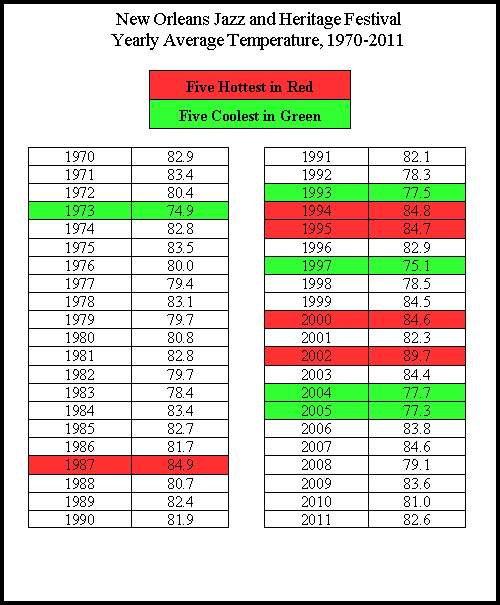

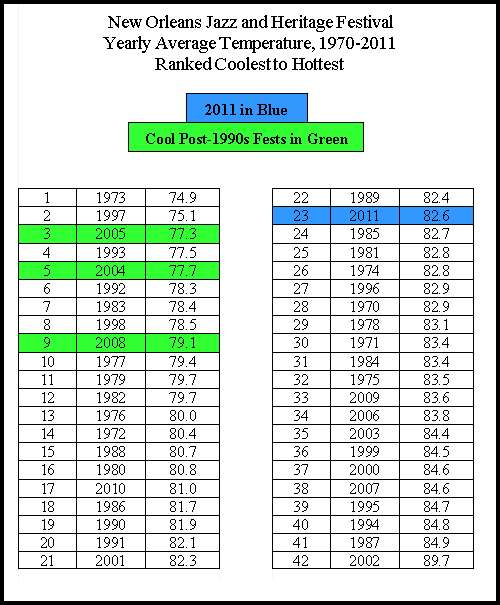
Conclusions? The 2011 was statistically right in the middle of all of them; three of the five hottest Jazz Fests were between 1987 and 1995, and three of the ten coolest Jazz Fests have been since 2004. There is no global warming trend evident at Jazz Fest.
Full blog post...
At one point Houck recites a litany of the worst predictions of rising global temperatures and, to try to make it more relevant to us here in New Orleans, flippantly says:
So what? Here in Louisiana we will be warmer in summer (think, maybe, 103 degrees at Jazz Fest) . . . . Houck, 19 Tul. Envtl. L. Rev 1, at 27.The source he cites says that:
[It] is projected that by 2100, temperatures in Louisiana could increase about 3°F (with a range of 1-5°F) in spring and summer, slightly less in winter, and slightly more in fall. Envtl. Prot. Agency, Climate Change and Louisiana 2 (1997).(See last year’s discussion for the minor problems with this cite in Houck’s article.)
Since I had been to many Jazz Fests when I read this article, and never remembered the temperature being in the high nineties, I thought this "prediction" was way off base and then, of course, had to figure out when the hottest JazzFests on record were. My original post on this, in 2009, talks about how I got the temperatures for all the past Jazz Fest (a pain in the ass) and about my methodologies in compiling them. Long story short, the hottest Jazz Fest ever was 2002, when the average temperature for the ten days of the Festival period was 89.7°F. Pretty damn hot, but a good thirteen degrees away from 103°F that Houck predicts and well out of even the maximum range by which the EPA says temperatures “could increase.”
This year’s Jazz Fest, with an average temperature of 82.6°F, was the 20th hottest on record. Here are the updated charts, current through the 2011 New Orleans Jazz and Heritage Festival.
Conclusions? The 2011 was statistically right in the middle of all of them; three of the five hottest Jazz Fests were between 1987 and 1995, and three of the ten coolest Jazz Fests have been since 2004. There is no global warming trend evident at Jazz Fest.
Full blog post...
Tuesday, May 4, 2010
Jazzfest, and Global Warming: The First Annual Update
Well, “first annual update” since I initially addressed this last year. In brief summary, Professor Oliver Houck of Tulane School of Law, in his article Can We Save New Orleans?, 19 Tul. Envtl L. Rev 1 (2006) (PDF), mentions several possible effects of climate change on New Orleans, including:
Last year I finally got around to researching the average temperatures of all Jazzfests during the past 40 years and, long story short, its never been so hot at Jazzfest that a 3 degree increase (or even, at the high end of the EPA range, a 5 degree increase), would get us anywhere close to 103 degrees: the hottest Jazzfest ever was 2002, with a average daily high temperature of 89.7 degrees (and, yes, I know, I know, you can argue that Prof. Houck was just being all folksy and informal, essentially saying “gosh-its-gonna-be-a-hunnert-an-three-at-Jazzfest-if-we-don’t-DO-something!!!”).
But this WAS written in a leading environmental law journal published by one of the country’s top fifty law schools and if this is the level of argument that counts as serious scholarship, then law professors everywhere should give up all pretense at objectivity and logic and just preach what they think the law SHOULD be. (Most of them are already doing this, but if they didn’t bother with “supporting” sources, citations, and footnotes, all these beleaguered law review students could be saved a lot of needless effort doing their sub-and-cites.)
So here’s my update of the charts I made last year, now including this year’s average temperatures at Jazzfest. (For the methodology, read last year’s post.) This year’s Jazzfest was in the cooler half of all 41 Jazzfests, with an average daily high of 81.0 degrees. Here’s the charts:
First, the average temperatures of all 41 Jazzfests, in chronological order:
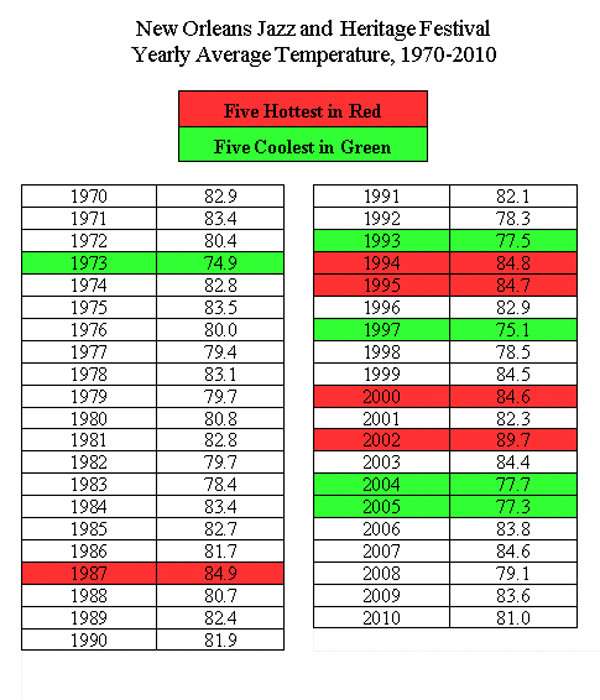
Yes, we had a very mild week and a half of Jazzfest, a full 2.6 degrees cooler than last year. And, yes, the climate change alarmists will say that normal variations may results in an unusually cool week and a half in a certain location despite “global warming”, but you’d be hard pressed to find one say that, by the same reasoning, normal variations may also result in an unusually hot week and a half (like Jazzfest was in 2002). The bottom line is we’re 23 degrees away from Prof. Houck’s apocalyptic - and totally unsupported by the source he cited in the relevant footnote in his article - prediction, and in the four years since he wrote this Jazzfest temperatures have been trending down.
Here are the 41 Jazzfests ranked hottest to coolest:

And ranked coolest to hottest:
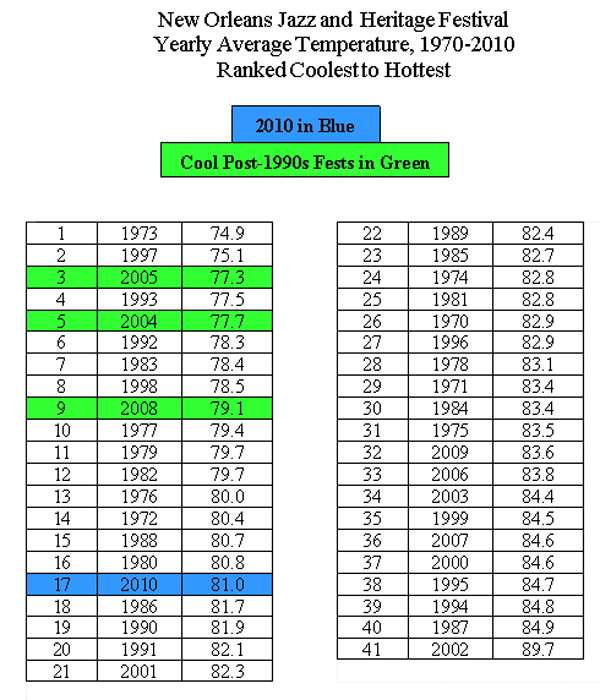
Conclusions, like last year, to be drawn are that, yes, the planet got measurably warmer in the past century but temperatures have reached a plateau and stayed at about the same point for the past decade, despite predictions that global temperatures should keep increasing steadily.
Even some of the anthropogenic global warming alarmists will admit this, though they can't all keep their stories straight. Last month, in his New York Times Magazine cover story, Building a Green Economy, Paul Krugman wrote:
Full blog post...
Here in Louisiana we will be warmer in summer (think, maybe, 103 degrees at Jazz Fest) .... Houck, 19 Tul. Envtl. L. Rev 1, at 27.But the source he cites to:
Envtl. Prot. Agency, Climate Change and Louisiana 3 (1997) available at http:// yosemite.epa.gov/OAR/globalwarming.nsf/UniqueKeyLookup/SHSU5BURCA/$File/la_ impct.pdfmerely says:
[It] is projected that by 2100, temperatures in Louisiana could increase about 3̊ F (with a range of 1-5̊ F) in spring and summer, slightly less in winter, and slightly more in fall. Envtl. Prot. Agency, Climate Change and Louisiana 2 (1997).(Yes, I found that on page 2 of this report; I didn't see any discussion of temperatures on page 3 like Prof. Houck cited. And the EPA report is no longer at the URL he provided in his article - a perfect example of link rot in law reviews - so I put it on Google Docs.)
Last year I finally got around to researching the average temperatures of all Jazzfests during the past 40 years and, long story short, its never been so hot at Jazzfest that a 3 degree increase (or even, at the high end of the EPA range, a 5 degree increase), would get us anywhere close to 103 degrees: the hottest Jazzfest ever was 2002, with a average daily high temperature of 89.7 degrees (and, yes, I know, I know, you can argue that Prof. Houck was just being all folksy and informal, essentially saying “gosh-its-gonna-be-a-hunnert-an-three-at-Jazzfest-if-we-don’t-DO-something!!!”).
But this WAS written in a leading environmental law journal published by one of the country’s top fifty law schools and if this is the level of argument that counts as serious scholarship, then law professors everywhere should give up all pretense at objectivity and logic and just preach what they think the law SHOULD be. (Most of them are already doing this, but if they didn’t bother with “supporting” sources, citations, and footnotes, all these beleaguered law review students could be saved a lot of needless effort doing their sub-and-cites.)
So here’s my update of the charts I made last year, now including this year’s average temperatures at Jazzfest. (For the methodology, read last year’s post.) This year’s Jazzfest was in the cooler half of all 41 Jazzfests, with an average daily high of 81.0 degrees. Here’s the charts:
First, the average temperatures of all 41 Jazzfests, in chronological order:
Yes, we had a very mild week and a half of Jazzfest, a full 2.6 degrees cooler than last year. And, yes, the climate change alarmists will say that normal variations may results in an unusually cool week and a half in a certain location despite “global warming”, but you’d be hard pressed to find one say that, by the same reasoning, normal variations may also result in an unusually hot week and a half (like Jazzfest was in 2002). The bottom line is we’re 23 degrees away from Prof. Houck’s apocalyptic - and totally unsupported by the source he cited in the relevant footnote in his article - prediction, and in the four years since he wrote this Jazzfest temperatures have been trending down.
Here are the 41 Jazzfests ranked hottest to coolest:
And ranked coolest to hottest:
Conclusions, like last year, to be drawn are that, yes, the planet got measurably warmer in the past century but temperatures have reached a plateau and stayed at about the same point for the past decade, despite predictions that global temperatures should keep increasing steadily.
Even some of the anthropogenic global warming alarmists will admit this, though they can't all keep their stories straight. Last month, in his New York Times Magazine cover story, Building a Green Economy, Paul Krugman wrote:
Second, climate models predicted this well in advance, even getting the magnitude of the temperature rise roughly right. While it’s relatively easy to cook up an analysis that matches known data, it is much harder to create a model that accurately forecasts the future. So the fact that climate modelers more than 20 years ago successfully predicted the subsequent global warming gives them enormous credibility. (Id. (Emphasis Added))Except that, according to a story on NPR - which you would expect to be hand in hand with Krugman and the New York Times on this:
Global warming skeptics have made quite a fuss over the fact the planet hasn’t actually warmed that much over the past decade, and there lies a genuine scientific mystery. The planet has been receiving more solar energy than it's been releasing back into space. Heat ought to be building up somewhere but scientists can't find it. Richard Harris, Examining A Climate Conundrum, All Things Considered, April 27, 2010.So which is it? Is the planet warming like the scientists predicted or are they baffled by how global warming has stalled in the past ten year? The NPR story at least references a few scientists and articles, which Krugman does not, and it concludes with a discussion of one scientist who has what is apparently the only working theory on this, and that he is finding
[E]vidence of warming deep in the ocean. He's still analyzing that data, so he can't yet say whether it will explain the entire paradox. But he says it will explain at least a chunk of it, and thats how science proceeds: mysteries, explanations, more questions and gradually deeper understanding. (Id.)So the data is still fresh, but the scientist is sure it will explain away the “apparent” lack of warming in the past decade. Thus NPR placates the alarmists with a pat re-assurance that this new research will explain the lack of predicted warming in the past decade and that - oh, relief - yes, mankind IS causing a catastrophic increase in global temperatures, but its just not evident right now. So please continues buying carbon credits from Al Gore.
Full blog post...
Sunday, May 17, 2009
Legal Scholarship, Global Warming, and Jazzfest
I've been thinking about this for a few years, ever since I read Can We Save New Orleans?, 19 Tul. Envtl L. Rev 1 (2006), by Professor Oliver Houck of Tulane School of Law. It's a very good, informal riff on a lot of the environmental issues related to New Orleans, Louisiana, the Mississippi River, all tied up in a nice bow of justifiable post-Katrina anger and personal narrative, including excerpts from Professor Houck's own evacuation journal.
What stood out in my mind from this article when I first read it was a rather specific prediction about global warming, though I slightly mis-remembered it - he doesn't give a time frame like I had thought he had (a lot of anthropogenic global warming alarmists tend to omit specific predictions of when the planet is going to be significantly hotter than whenever their spreading their current hysteria). But Professor Houck does give a specific temperature prediction linked to one of our big annual cultural events here in New Orleans:
As a librarian I deal in facts. Students sometimes think we know how to find anything, but I tell them that while that's not true, I do know how to find out how to find just about anything. So I spent some time learning about weather data the did some research and came up with the average high temperature for Jazz Fest during its 40 year history.
Jazz Fest has had different schedules over its forty year history, so to have a consistent year-to-year set of data, I used a constant set of ten days over the last weekend of April through the first weekend of may - the first Friday through the next weekend's Sunday, which has been the more-or-less consistent schedule for the Fest in the past 15 years or so. Also, I included the days between weekends because the second weekend of Jazz Fest has started to include that Thursday so this way I'm taking an average of the more-or-less same ten days year to year (and because your hardcore Jazz Fest fans make good use of these weekdays to continue enjoying the local music scene, some consider Jazz Fest to be the entire ten day period).
The National Climatic Data Center, part of NOAA, has its primary on-line climate data search here:http://cdo.ncdc.noaa.gov/CDO/cdo
It took me a while to figure it out - you submit your query and they actually e-mail you a link a little while later with the information you requested (the link lasts two weeks, but I saved the important data). The various data stations collect different data, and the range of years for which they collected data varies, and the stations nearest the fair grounds don't have complete data for these forty years so I used the main station at the New Orleans airport (which, I think, is the main station in this area - it definitely has the most complete data).
There's no way I could find to get just the data for certain dates, or just the April and May data, for all forty years, so I submitted a request for all forty years of data and then copied the daily high temperatures to my spreadsheet for each year's ten day Jazz Fest "period". (You can view either the original data from the NCDC (PDF) or my spreadsheet of the daily highs (also PDF)).
What I found out is this: the hottest Jazz Fest ever was 2002, when the average temperature was 89.1 degrees. The hottest single day ever was May 2 of that year, when the temperature was 92 degrees. So even if the upper range of the EPA's 1979 prediction is correct, Jazz Fest might be 97 degrees in a hundred years. Still damn hot, but well short of 103 degrees.
Looking over the numbers, its clear there is no definitive warming trend; the second hottest Jazz Fest was 1987, when the average temperature was 84.9 degrees. This year was the tenth hottest (84.9 degrees), but the eleventh, thirteenth, and fourteenth hottest Jazz Fests were all in the 1970s: 1975, 1971, and 1978 - 83.5, 83.4, and 83.1 degrees, respectively. AND the third, fifth, and ninth coolest Jazz Fests were all in the last four years: 2005, 2004, and 2009 - 77.3, 77.7, and 79.1 degrees, respectively.
The full numbers are sorted different ways in the next three charts. Here's the average high temperatures for all forty years, in chronological order (click any of these charts to see larger versions):

And, because there's no shortage of fun things you can do while number crunching, here's the forty years of Jazz Fest ranked from hottest to "coolest" (74.9 degrees is "cool" here in New Orleans):

and here it is the data, coolest to hottest:

Conclusions? Yes, the planet has gotten warmer in the past century or so. But these Jazz Fest temperatures are consistent with a more realistic view of climate change than the anthropogenic alarmists have: there hasn't been a clear "hockey stick" temperature increase in the past few decades and its likely that what warming we have seen peaked in the late 1990s and that natural variations dwarf mankind's contributions to warming the planet.
Full blog post...
What stood out in my mind from this article when I first read it was a rather specific prediction about global warming, though I slightly mis-remembered it - he doesn't give a time frame like I had thought he had (a lot of anthropogenic global warming alarmists tend to omit specific predictions of when the planet is going to be significantly hotter than whenever their spreading their current hysteria). But Professor Houck does give a specific temperature prediction linked to one of our big annual cultural events here in New Orleans:
Here in Louisiana we will be warmer in summer (think, maybe, 103 degrees at Jazz Fest) .... Houck, Tul. Envtl. L. Rev 1, at 27.For one, the "maybe" in the parenthetical is his big weasel-word out of pulling the specific figure of 103 degrees out of thin air. The rest of his sentence discusses predicted drier conditions and the effect that may have on our state's leading crops and then a footnote for that sentence refers to (after an "id." or two) this:
Envtl. Prot. Agency, Climate Change and Louisiana 3 (1997) available at http:// yosemite.epa.gov/OAR/globalwarming.nsf/UniqueKeyLookup/SHSU5BURCA/$File/la_ impct.pdfThe only part of that four-page report that I found which predicted specific temperature change in Louisiana was this:
[It] is projected that by 2100, temperatures in Louisiana could increase about 3°F (with a range of 1-5°F) in spring and summer, slightly less in winter, and slightly more in fall. Envtl. Prot. Agency, Climate Change and Louisiana 2 (1997).Like a lot of the source material cited by alarmists, it's a bit more measured than the attention-grabbing headlines and statements: "could increase" anywhere from one to five degrees in a hundred years. But 103 degrees at Jazz Fest? Yes, Jazz Fest is hot: it's a music festival with tens of thousand of people crowded onto a dirt and asphalt racetrack and fairgrounds in late spring. Is it really likely to be 103 degrees there any time soon? Ever?
As a librarian I deal in facts. Students sometimes think we know how to find anything, but I tell them that while that's not true, I do know how to find out how to find just about anything. So I spent some time learning about weather data the did some research and came up with the average high temperature for Jazz Fest during its 40 year history.
Jazz Fest has had different schedules over its forty year history, so to have a consistent year-to-year set of data, I used a constant set of ten days over the last weekend of April through the first weekend of may - the first Friday through the next weekend's Sunday, which has been the more-or-less consistent schedule for the Fest in the past 15 years or so. Also, I included the days between weekends because the second weekend of Jazz Fest has started to include that Thursday so this way I'm taking an average of the more-or-less same ten days year to year (and because your hardcore Jazz Fest fans make good use of these weekdays to continue enjoying the local music scene, some consider Jazz Fest to be the entire ten day period).
The National Climatic Data Center, part of NOAA, has its primary on-line climate data search here:http://cdo.ncdc.noaa.gov/CDO/cdo
It took me a while to figure it out - you submit your query and they actually e-mail you a link a little while later with the information you requested (the link lasts two weeks, but I saved the important data). The various data stations collect different data, and the range of years for which they collected data varies, and the stations nearest the fair grounds don't have complete data for these forty years so I used the main station at the New Orleans airport (which, I think, is the main station in this area - it definitely has the most complete data).
There's no way I could find to get just the data for certain dates, or just the April and May data, for all forty years, so I submitted a request for all forty years of data and then copied the daily high temperatures to my spreadsheet for each year's ten day Jazz Fest "period". (You can view either the original data from the NCDC (PDF) or my spreadsheet of the daily highs (also PDF)).
What I found out is this: the hottest Jazz Fest ever was 2002, when the average temperature was 89.1 degrees. The hottest single day ever was May 2 of that year, when the temperature was 92 degrees. So even if the upper range of the EPA's 1979 prediction is correct, Jazz Fest might be 97 degrees in a hundred years. Still damn hot, but well short of 103 degrees.
Looking over the numbers, its clear there is no definitive warming trend; the second hottest Jazz Fest was 1987, when the average temperature was 84.9 degrees. This year was the tenth hottest (84.9 degrees), but the eleventh, thirteenth, and fourteenth hottest Jazz Fests were all in the 1970s: 1975, 1971, and 1978 - 83.5, 83.4, and 83.1 degrees, respectively. AND the third, fifth, and ninth coolest Jazz Fests were all in the last four years: 2005, 2004, and 2009 - 77.3, 77.7, and 79.1 degrees, respectively.
The full numbers are sorted different ways in the next three charts. Here's the average high temperatures for all forty years, in chronological order (click any of these charts to see larger versions):

And, because there's no shortage of fun things you can do while number crunching, here's the forty years of Jazz Fest ranked from hottest to "coolest" (74.9 degrees is "cool" here in New Orleans):

and here it is the data, coolest to hottest:

Conclusions? Yes, the planet has gotten warmer in the past century or so. But these Jazz Fest temperatures are consistent with a more realistic view of climate change than the anthropogenic alarmists have: there hasn't been a clear "hockey stick" temperature increase in the past few decades and its likely that what warming we have seen peaked in the late 1990s and that natural variations dwarf mankind's contributions to warming the planet.
Full blog post...
Sunday, May 3, 2009
Jazz Fest: Music, Food, and Tattoos
Besides the great music and food, Jazzfest is an amazing place for people-watching. There’s no shortage of interesting tattoos in this city, but I got pictures of three that were particularly notable.
Carpe Diem:

Great advice, but a strange choice of location to put this on your foot.
Cadillac Logo:

I hope he got paid for this.
And, my favorite, Bugs Bunny as da Vinci’s Vitruvian Man:

Full blog post...
Carpe Diem:
Great advice, but a strange choice of location to put this on your foot.
Cadillac Logo:
I hope he got paid for this.
And, my favorite, Bugs Bunny as da Vinci’s Vitruvian Man:
Full blog post...
Wednesday, April 29, 2009
Designer Swine Flu Surgical Masks for Jazzfest?
People in Mexico in the thick of the swine flu scare are making the best of the half-baked preventative measure of wearing surgical masks in public by decorating them:

Here in New Orleans, the second weekend of Jazzfest starts tomorrow, and by then the first case in Louisiana may have been identified (and identified a mere six or seven blocks from the law school), so in keeping with the spirit of dressing up for the festival, there may be plenty of decorative mask in evidence. Or not - its going to be pretty hot...
But I worked up some quick and sloppy "proof of concept" images for decorative surgical mask built around some obvious ideas, most of which violate copyright to one extent or another. The original is from some Sims mod site:

So the first obvious thing to do is replace the radiation symbol with the biohazard symbol:

And then its time to get creative. For example,
The Smiley Face Flu Mask ("Don't worry, be happy"):

The Rocky Horror Flu Mask (And God said "let there be hog lips"):

The Alf Flu Mask ("Whoa. Has the hunter angered the gods? Okay, I won't eat pork."):

The Rolling Stone Logo Flu Mask ("I'll give you a job for to feed my swine", Prodigal Son, from Beggars Banquet):

and finally, the Groucho Marx Nose-and-Glasses Flu Mask ("I would never be part of a pandemic that would have me as a victim"):

Full blog post...
Subscribe to:
Posts (Atom)